The Owl’s Invoice
In much of Kenya, an owl on the roof means someone is about to die, so we chase it away. But that owl was guarding our maize from rats, for free. We’re going to send farmers the bill.
A ResiGrow Africa pilot, planned for early 2027 on farms beside Saiwa Swamp National Park, Trans Nzoia, Kenya.
Night rodent control, maize fields and stores
Sample invoice. Real ones start with the pilot.
We chase away the one worker guarding our maize.
It’s a loop that feeds itself, and it runs on a belief.
The owl is chased off
An owl near a house is read as a death omen, so it gets shouting, stones, fire, or worse.
Rats multiply
With fewer owls hunting, rats and mice move into the fields and the maize stores.
Farmers buy poison
Rat poison has to be bought again every season, and it lies around homes and stores.
The next owl dies
Owls, eagles, cats and dogs that eat poisoned rats are poisoned too.
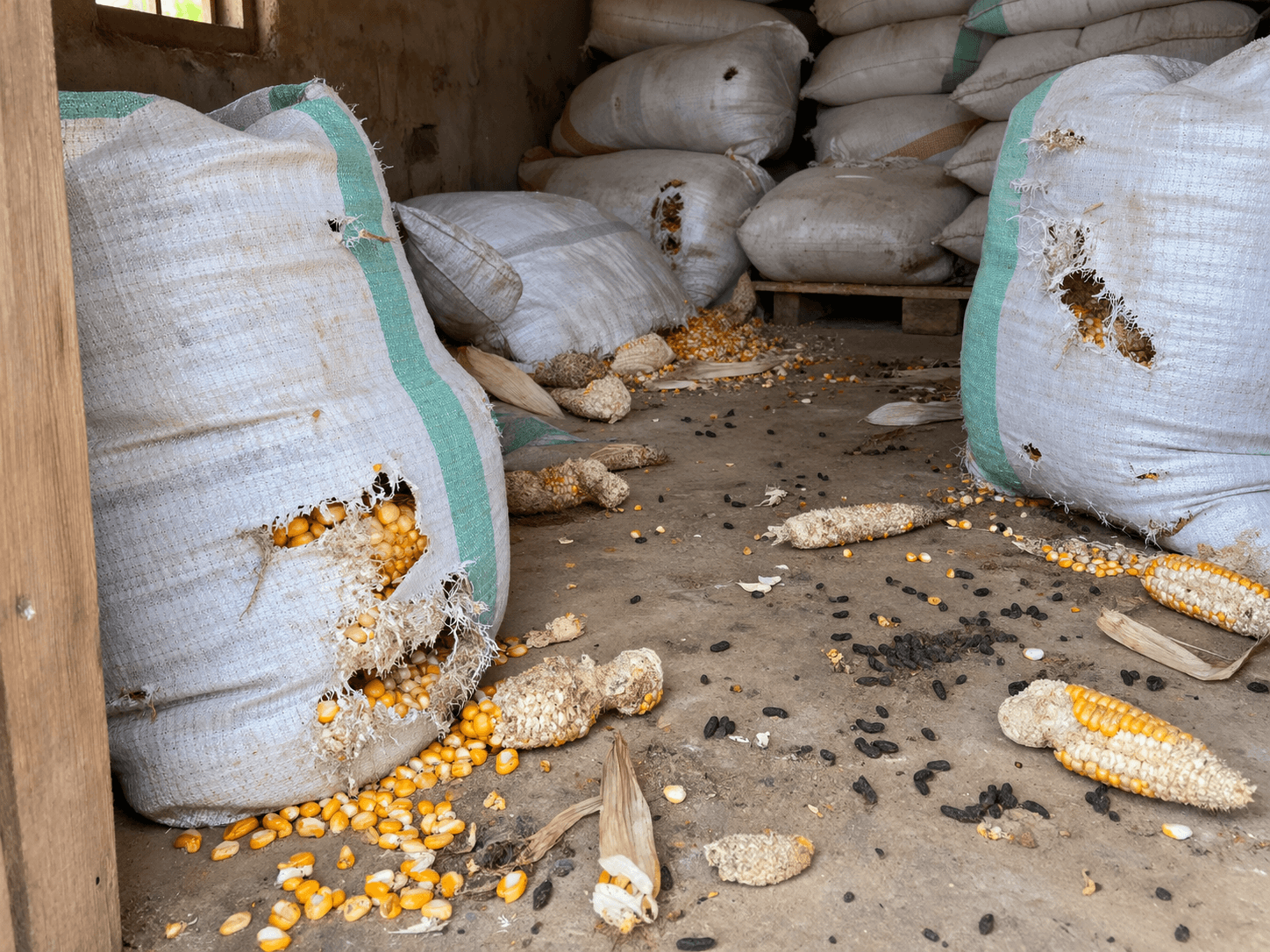
Up to 43% of storage losses. In Kenyan farm stores, rodents caused up to 43% of losses where maize was kept on the cob, and grain they damaged carried more mould and aflatoxin. Source
80% link owls with bad omens. In a 19-country study of owl beliefs, about 80% of East Africans interviewed associated owls with death or disaster. Source
Owls can’t digest bones.
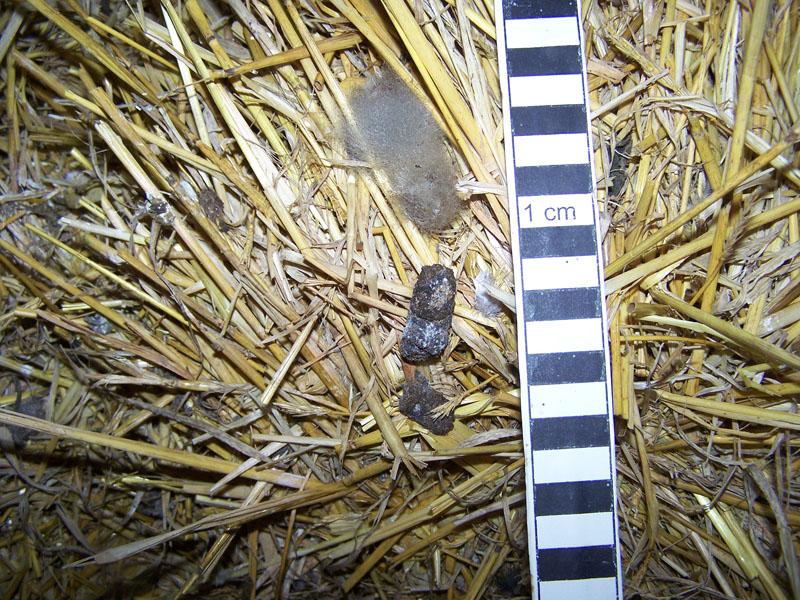
Every day, an owl coughs up a pellet: a small grey bundle of fur holding the skulls of everything it ate. Pellets pile up under roosts in trees and old stores across our farms. Count the skulls and you know exactly how many rats that owl removed.
Under every roost lies a pile of receipts. Nobody reads them.
How the invoice works
We don’t ask anyone to give up a belief. We show them the evidence and let them decide.
Find the roosts
Farmers show us where they hear owls at night. By day we search those trees and stores for pellets.
Count the skulls
Each pellet is opened and every skull counted and named: rat, mouse or shrew.
Deliver the invoice
Each household gets a monthly bill from the owl next door. Amount due: KES 0.
Open pellets together
At public pellet nights, farmers and pupils pull the skulls out with their own hands.
Give the owl a home
Nest boxes on poles in open fields, away from houses, plus perches to hunt from.
The science is already done next door.
In a 2023–24 trial in the maize fields of Iringa, Tanzania, researchers compared farms with barn owl nest boxes against farms without.
Rodents caught in field trapping
Maize harvest, kg per hectare
Kenya’s missing piece isn’t evidence. It’s belief.
Source: Daniel, Shechambo, Martin and Sabuni (2026), East African Journal of Agriculture and Biotechnology.
The pilot: 90 days beside Saiwa Swamp
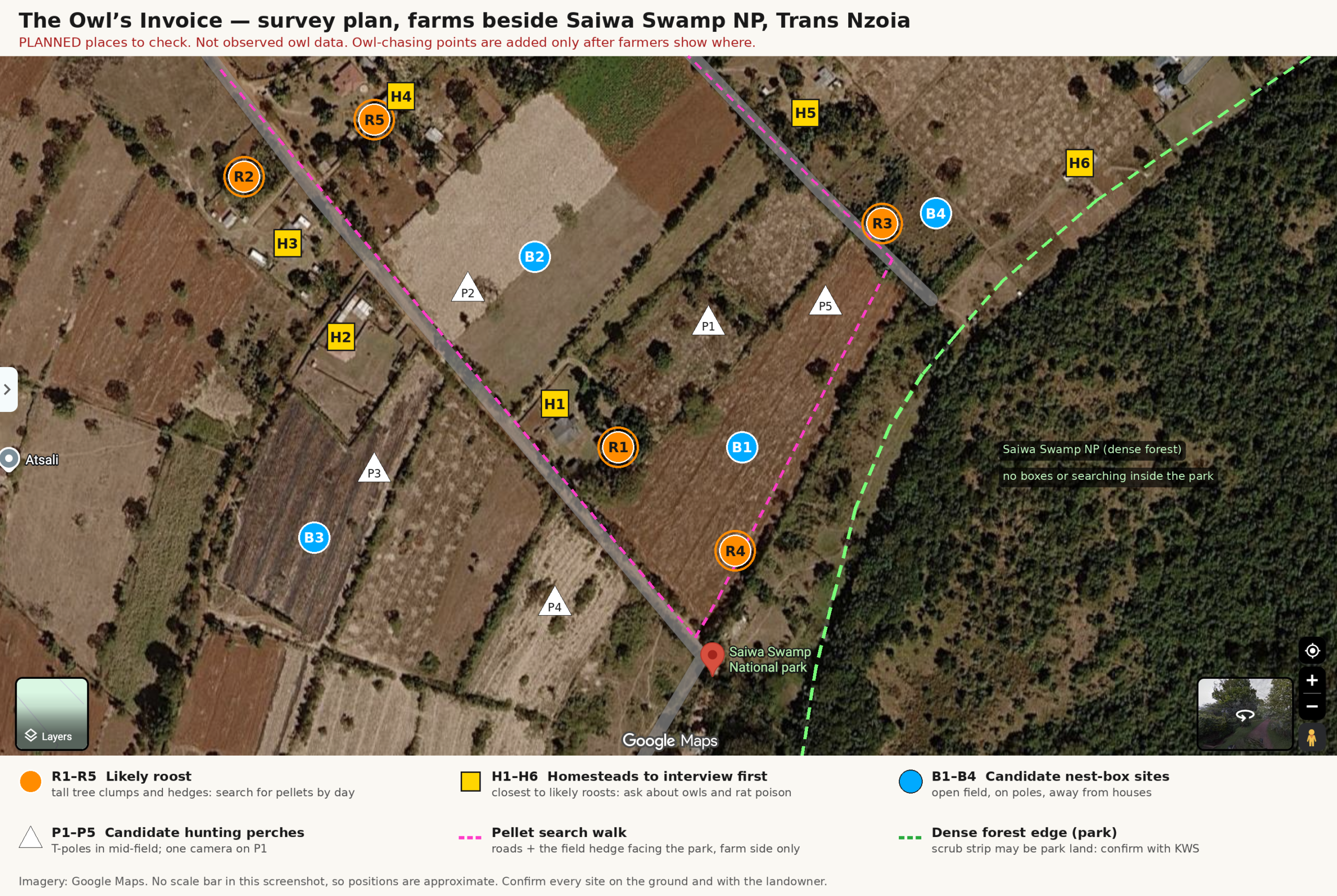
Saiwa Swamp is Kenya’s smallest national park, ringed by smallholder maize farms near Kitale. Every box and every pellet search will be on private farms, with each owner’s permission.
- 8
- owl nest boxes on poles in open fields
- 12
- hunting perches across the farms
- 20
- households receiving a monthly invoice
- 16
- farms compared: 8 with boxes, 8 without
- 60
- households asked about owls and rat poison, before and after
- 2
- night cameras watching the perches
Saiwa Swamp National Park, Trans Nzoia County. The pilot farms sit around its edge.
- Days 1–15
Prepare
Survey households, map owl calls, build the boxes.
- Days 16–30
Launch
Mount boxes and perches. First pellets, first invoice.
- Days 31–60
Collect
Weekly pellet rounds, camera checks, first pellet night.
- Days 61–75
Evaluate
Repeat the survey and the rodent checks on all 16 farms.
- Days 76–90
Share
Third invoice, the skull wall, and the free kit.
What we’ll count, and what we won’t claim
Counts, not claims. If something doesn’t work, we’ll publish that too.
- Rodent skulls in pellets, by species
- Owl visits to perches, filmed at night
- Signs of owls using the nest boxes
- Rodent activity on farms with boxes against farms without
- Rat damage in maize stores, at the start and the end
- Households who would chase or kill an owl, before and after the invoices
- Households using rat poison
- Farmers who offer to pay part of a box themselves. This is the number that matters most.
What 90 days can’t show
- Owls breeding in the new boxes. That can take a season or more.
- A drop in rats across the whole area. Eight boxes can’t do that.
- A climate figure. Any number we gave you would be invented.
Where the money goes
The whole pilot costs $990. Every dollar buys something that stays on the farms or measures what happens. None of it pays a salary.
| Item | Quantity | Cost (USD) |
|---|---|---|
| Barn owl nest boxes, built by a Kitale carpenter | 8 | 312 |
| Treated timber poles, 5–6 m | 8 | 128 |
| Galvanised guards to keep snakes off the poles | 8 | 40 |
| Hunting perches | 12 | 72 |
| Night-vision camera traps | 2 | 150 |
| Memory cards and rechargeable batteries | 1 set | 30 |
| Pellet kit: forceps, trays, hand lens, gloves, scale | 1 | 40 |
| Rodent tracking boards and bait trays | 1 kit | 25 |
| Store-loss check: hanging scale and sample sacks | 1 kit | 35 |
| Printed invoices, skull charts and skull boards | 1 lot | 45 |
| Materials for two public pellet nights | 2 | 35 |
| Casual labour to dig and mount 20 poles | 6 days | 48 |
| One delivery of poles and boxes to the farms | 1 | 30 |
| Total | 990 |
Questions we hear
Isn’t an owl a bad omen?
Many of us grew up hearing that. An owl near a home is there for the rats and mice around the house and the store, not for the people. We don’t argue with anyone’s beliefs. We put the boxes out in the fields, away from houses, and let the skull count speak.
How many rats does one owl really eat?
An adult barn owl takes about one or two rodents a night. A pair raising chicks can take more than 1,000 in a year (UC Davis). The pellets let us count the real number on our own farms.
Will the owls take my chickens?
Barn owls hunt mice, rats and shrews. A grown chicken is several times heavier than the owl itself.
Why not just use rat poison?
Poison costs money every season, and it doesn’t stay with the rats. Owls, eagles, cats and dogs that eat a poisoned rat can die too. A nest box is paid for once and keeps working for years.
Is any of this happening inside the national park?
No. Every box, perch and pellet search is on private farms, with the owner’s permission. We never handle or chase owls, and never open a box with an owl nesting in it.
Can my village copy this?
Yes, that’s the point. At the end of the pilot we’ll publish a free kit: a nest-box plan, the invoice template in English and Swahili, a skull identification chart and a pellet-night lesson plan. You need a carpenter, a pole and a printer.
Help us send the first invoices
Farmers near Saiwa Swamp
Tell us where you hear owls at night, or offer a corner of a field for a nest box.
Owl and wildlife experts
Help us identify skulls, choose box sites and check our methods.
Supporters
The boxes, cameras and first invoices cost under $1,000. Help us cover them, or introduce us to someone who can.
Or write to hello@resigrowafrica.com.
The Owl’s Invoice is a pilot by ResiGrow Africa, Kitale, Kenya, led by Kennedy Washika, a geographer and GIS practitioner.
Sources
- Daniel et al. (2026), barn owl nest boxes and maize yields, Tanzania
- Owl knowledge and beliefs in Africa (19-country interview study)
- Audubon: persecution and the monitoring gap for Kenya’s owls
- Ognakossan et al., rodent losses in on-farm stored maize, Kenya
- Ingels, Use of barn owls to control rodents on farms, UC Davis